VERTEBRAL COLUMN OVERVIEW

Vertebral Column - Overview, Preview from the app. Download 3D OSTEOLOGY for full 3D control—multiple views, x-ray mode, and unlimited zoom.
TABLE OF CONTENTS
OVERVIEW
- The spine, composed of vertebrae from the skull to the coccyx, protects the spinal cord within the vertebral canal
- Supports the head and provides attachment for ribs and back muscles
- Features primary and secondary curvatures that enhance balance, flexibility, and structural integrity
- Contains the vertebral canal that houses the spinal cord
Vertebral Regions
- The vertebral column is composed of vertebrae and consists of distinct regions:
- Cervical region:
- Seven vertebrae (C1-C7)
- Supports the head and allows for neck movement
- Thoracic region:
- Twelve vertebrae (T1-T12)
- Articulates with the ribs
- Lumbar region:
- Five vertebrae (L1-L5)
- Bears most of the body weight
- Sacrum:
- Five fused vertebrae
- Forms the posterior wall of the pelvis
- Coccyx:
- Three to four fused vertebrae
- Vestigial tailbone
PRIMARY CURVATURES

Primary Curvatures of the Vertebral Column, Preview from the app. Download 3D OSTEOLOGY for full 3D control—multiple views, x-ray mode, and unlimited zoom.
- Natural curves present at birth
- Include thoracic and sacral regions (concave forward)
Thoracic Kyphosis
- Outward curvature of the thoracic spine (upper back)
- Extends from the middle of the second to the twelfth thoracic vertebra
- Provides space for thoracic organs
Sacral Kyphosis
- Outward curvature of the sacrum and coccyx (pelvic region)
- Extends from the sacrovertebral articulation to the coccyx tip
- Forms the posterior wall of the pelvic cavity
SECONDARY CURVATURES
- Develop after birth as the child lifts the head and starts walking
- Include cervical and lumbar regions (convex forward)
Cervical Lordosis
- Forward curvature of the cervical spine
- Extends from the atlas (first vertebra) to the middle of the second thoracic vertebra
- Supports the head
- Develops when infant begins to hold head up
Lumbar Lordosis
- Forward curvature of the lumbar spine (lower back)
- Extends from the middle of the last thoracic vertebra to the sacrovertebral angle
- Supports upper body weight and aids in movement
- Develops when child begins to walk
VERTEBRAL CANAL
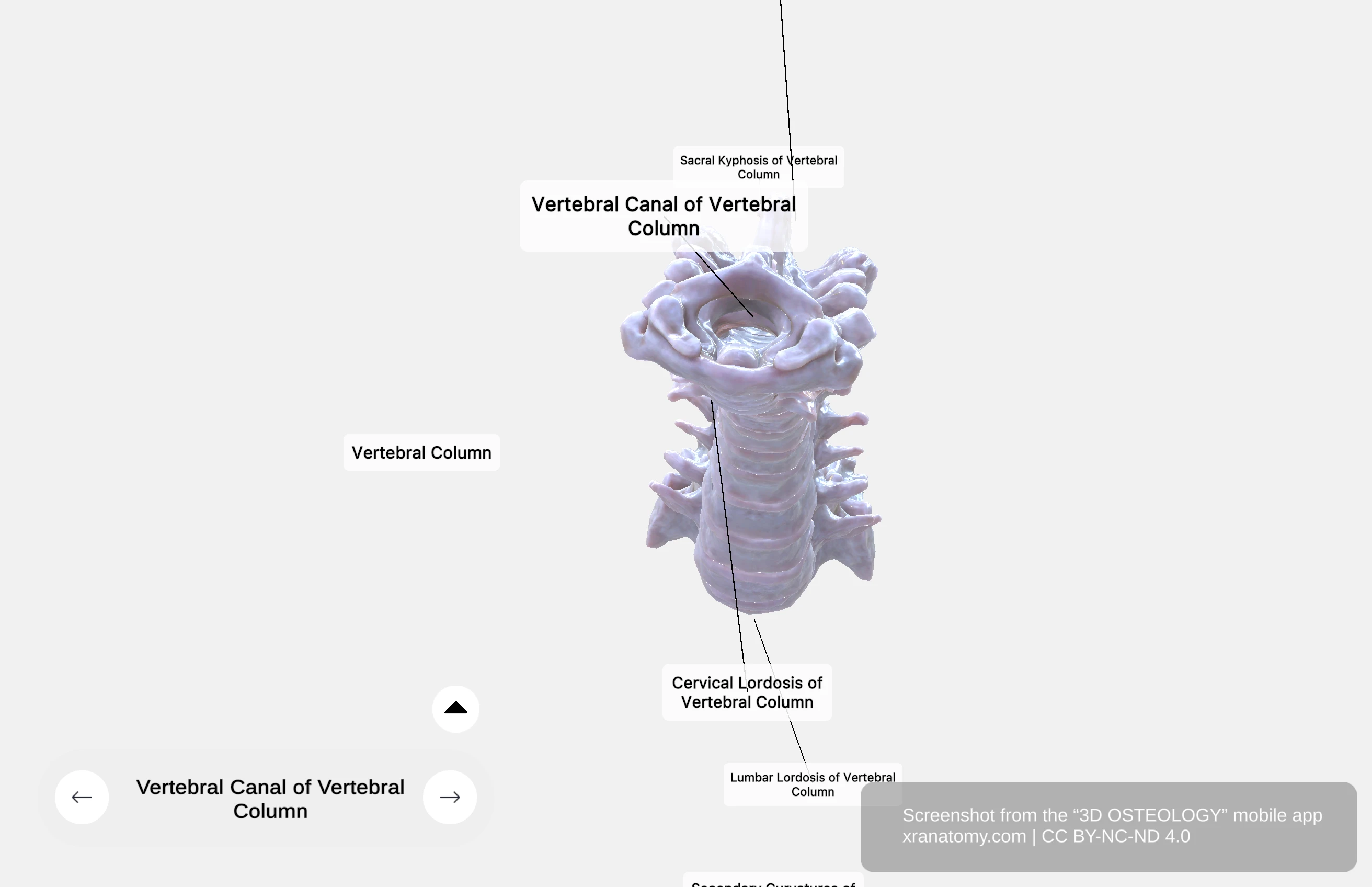
Vertebral Canal, Sourced from the app 3D OSTEOLOGY
- Hollow tube formed by the alignment of vertebral foramina
- Houses and protects the spinal cord
- Shape and size vary by region to accommodate mobility:
- Larger in cervical and lumbar regions for greater nerve distribution
- Narrower in thoracic region
- Contains the meninges, spinal cord, and cerebrospinal fluid
BIBLIOGRAPHY
1. Henry G, Warren HL. Osteology. In: Anatomy of the Human Body. 20th ed. Philadelphia: Lea & Febiger; 1918. p. 129–97.